
SKR·01VISION
Sees a drone, not a cloud.
The seeker's detection network discriminates a small UAS from clouds, sun halo, and open-sky clutter — the false-alarm sources that defeat naive motion tracking. Trained and evaluated on real sky footage.

PICKET is a shoulder-launched, passive-seeker kinetic interceptor for fiber-optic FPV drones — the drones jamming can't stop.
The FPV attack drone turned a few hundred dollars of hobby hardware into a precision-strike weapon. The defense that emerged is electronic warfare: jam the radio control link, and the aircraft drops.
The fiber-optic variant removes the link. Guidance travels down a physical fiber unspooled in flight — nothing radiates, so nothing can be jammed or spoofed, and there is no signal for RF sensors to find. Against the primary counter-drone defense fielded today, it is simply immune.
A hair-thin optical fiber unspools behind the aircraft, kilometers long. Control never touches the radio spectrum.
None. Jamming and spoofing do not apply, and there is no RF signature to detect or direction-find.
Commodity FPV components — cheap enough to spend freely against anything worth protecting.
An EW-immune threat needs a physical answer: see it optically, stop it kinetically.
A man-portable, shoulder-launched interceptor. At its core is a passive electro-optical / infrared seeker that detects, locks, and tracks the target entirely on-board — no operator link, no illumination — and guides the airframe to a kinetic intercept.
The seeker is the hard part — and it is our IP.
Passive means zero emissions: nothing for the target to detect, nothing for anyone to jam. The same immunity the fiber gives them, optics give us.
Passive EO/IR. All detection, lock, and track processing runs on-board the round.
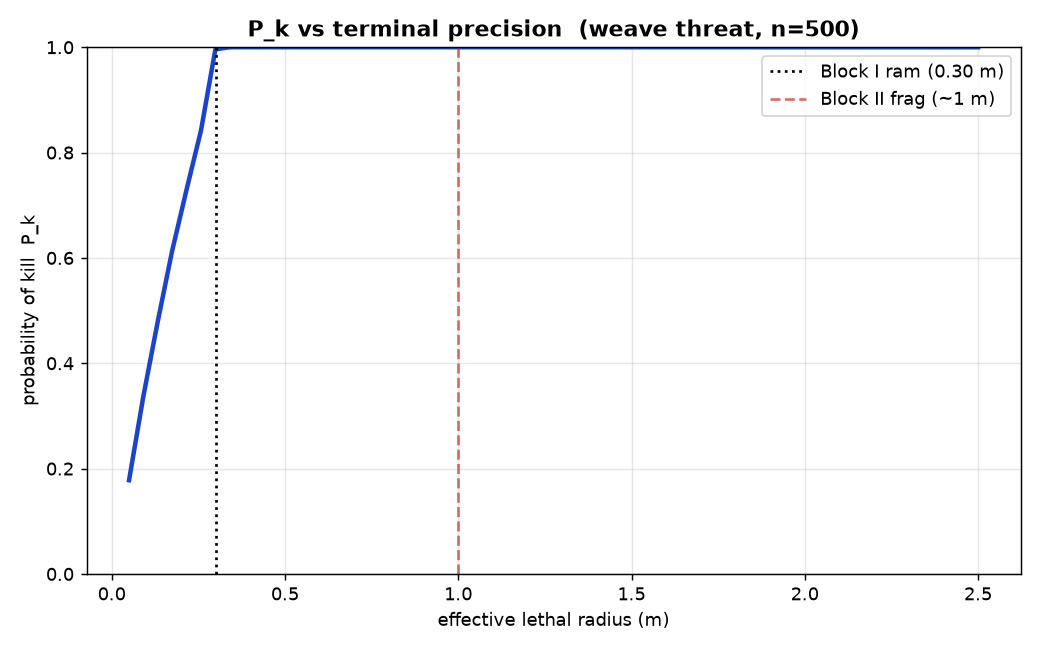
Kinetic intercept. Block I: direct ram. Block II: proximity fragmentation — roadmap.
Shoulder-launched, man-portable, single operator. The operator's job ends at launch.
Detect, lock, launch, guide, intercept — the full PICKET sequence against the drone jamming can't stop, drawn as a concept schematic in the seeker's own language. Not simulation output, not test footage.
What exists today, measured — on the bench and in simulation.
The seeker's detection network discriminates a small UAS from clouds, sun halo, and open-sky clutter — the false-alarm sources that defeat naive motion tracking. Trained and evaluated on real sky footage.
Detection cues an on-board tracker that locks the target and holds it through brief dropouts — occlusion, glare, frame loss — re-acquiring without operator input.
Guidance laws run against evasive, weaving targets in a Monte-Carlo intercept simulator — hundreds of runs per configuration, before any hardware flies.
The full detect–lock–track pipeline runs in real time on commodity edge hardware. An interceptor only makes sense if it costs a fraction of what it protects.
Four gates, in order. Each stage retires one class of risk before the next begins.
Detect–lock–track running against recorded and live sky footage on bench hardware.
Seeker flown on a surrogate airframe against real targets — closure geometry, vibration, optics.
Unguided test launches — airframe, propulsion, and safe-separation work.
Closed-loop guided intercept of a target drone. The proof.
Cobalt Dynamics is an early-stage Israeli defense-technology company, founded and led by an Israeli Air Force veteran. We are building the seeker first: it is the hardest part of the problem and the heart of the system. Everything else on this page is staged behind it, in the order the risk deserves.